About this book
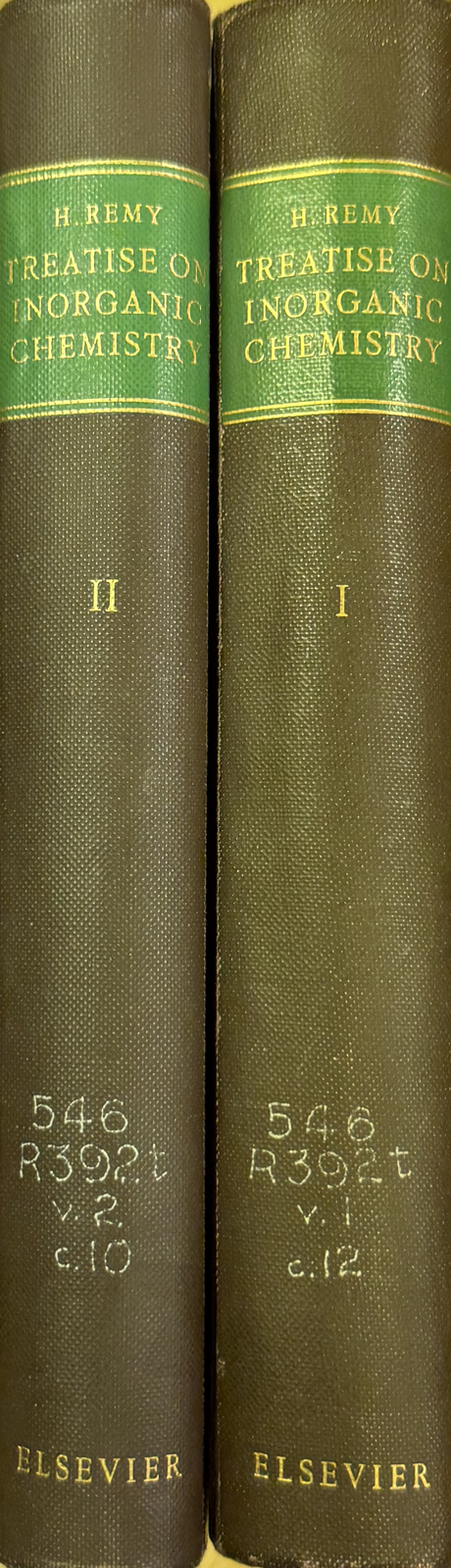
Published in English in 1956, Heinrich Remy’s two-volume Treatise on Inorganic Chemistry brought a repeatedly revised German reference to a wider scientific readership. J. S. Anderson translated it and J. Kleinberg edited it. Contemporary reviews emphasized its integration of chemical facts with thermodynamics, reaction kinetics and atomic and crystal structure—a record of the increasingly physical approach to inorganic chemistry in the mid-twentieth century.
Volume I covers the introduction and main groups of the periodic table. Volume II treats the sub-groups and general topics, including the lanthanides, transuranic elements, catalysis, non-aqueous chemistry, radioactivity and nuclear chemistry. Together they document how expanding knowledge of elements and nuclear science entered the reference literature used to train and support chemists.
This matching brown-cloth set retains Los Alamos Scientific Laboratory library-property stamps dated January 29, 1957, on both title pages, together with spine classification marks. The photographed Volume I pocket and card are marked GMX-2-LIB. GMX was Los Alamos’ Weapons Physics Division: the Atomic Energy Commission’s 1954 organizational account assigns it research on rapid weapon assembly and initiation, together with the physical, chemical and metallurgical properties of explosives. Within this division, GMX-2 was the Explosives Research Development and Pilot-scale Engineering group. These surviving marks connect the set to the laboratory’s working reference collections during the Cold War; they do not identify a particular reader or establish use on a specific weapon or experiment. The cloth shows shelf wear and the pages are age toned. Both volumes are present.