About this book
Hilbert and Ackermann’s Grundzüge der theoretischen Logik helped establish the modern presentation of mathematical logic, systematically developing propositional and first-order predicate logic through explicit symbols, axioms and rules of proof.
The 1928 first edition formulated two questions that became central to twentieth-century logic. It asked whether every logically valid first-order statement could be proved—a question Gödel answered affirmatively in his 1929 dissertation, published in 1930. It also emphasized the Entscheidungsproblem: whether a general mechanical procedure could decide logical validity. Church and Turing established the impossibility of such a procedure in 1936. These are distinct results: completeness of a proof system does not guarantee a decision method.
The book therefore stands at an important junction between the foundations of mathematics and the emergence of computability theory. It records the questions before their decisive resolution; it does not contain those later results.
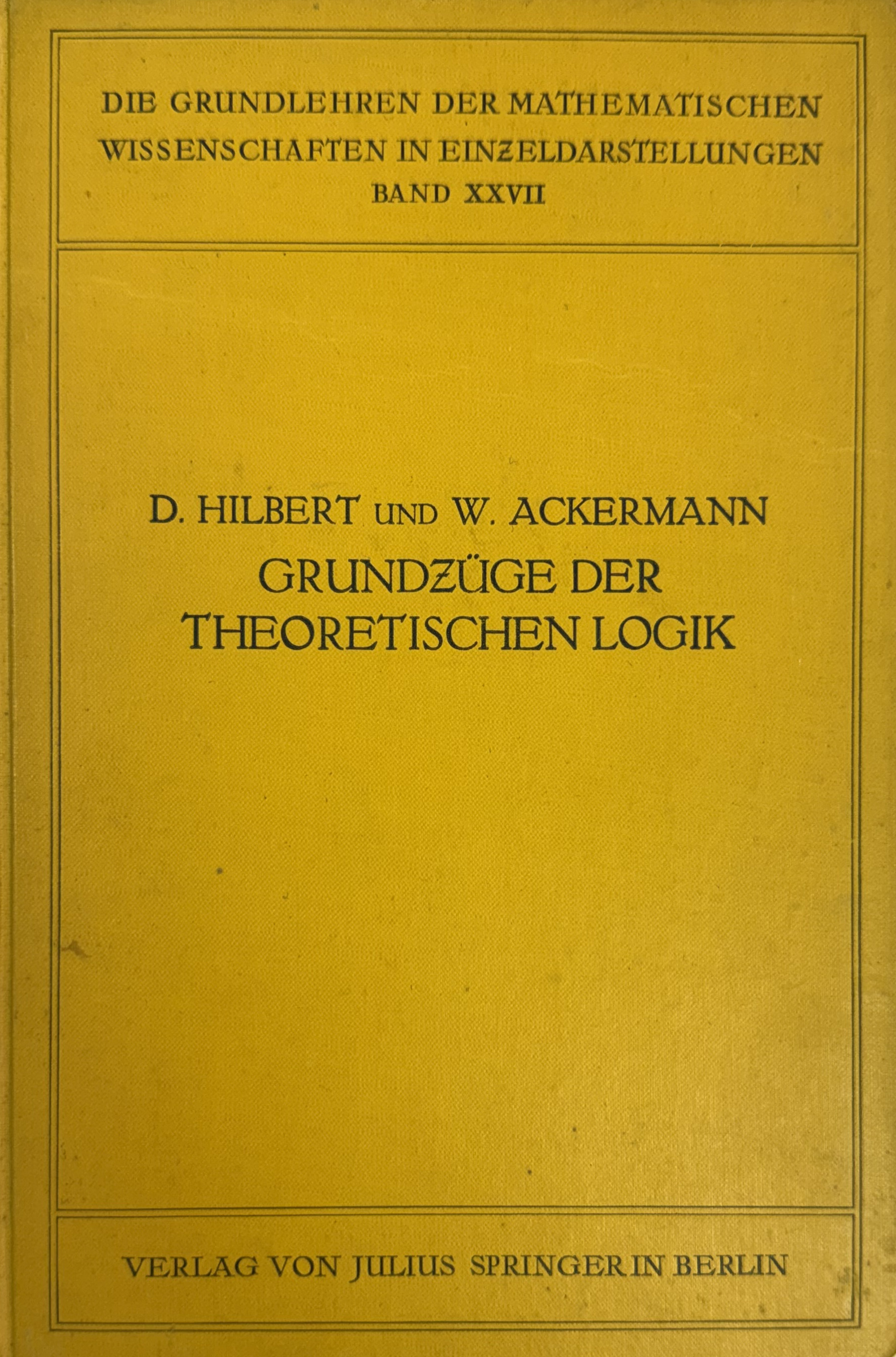
This first-edition Springer volume is dated 1928 and numbered XXVII in its series. The yellow binding shows edge wear. No author autograph or particular institutional use is claimed.