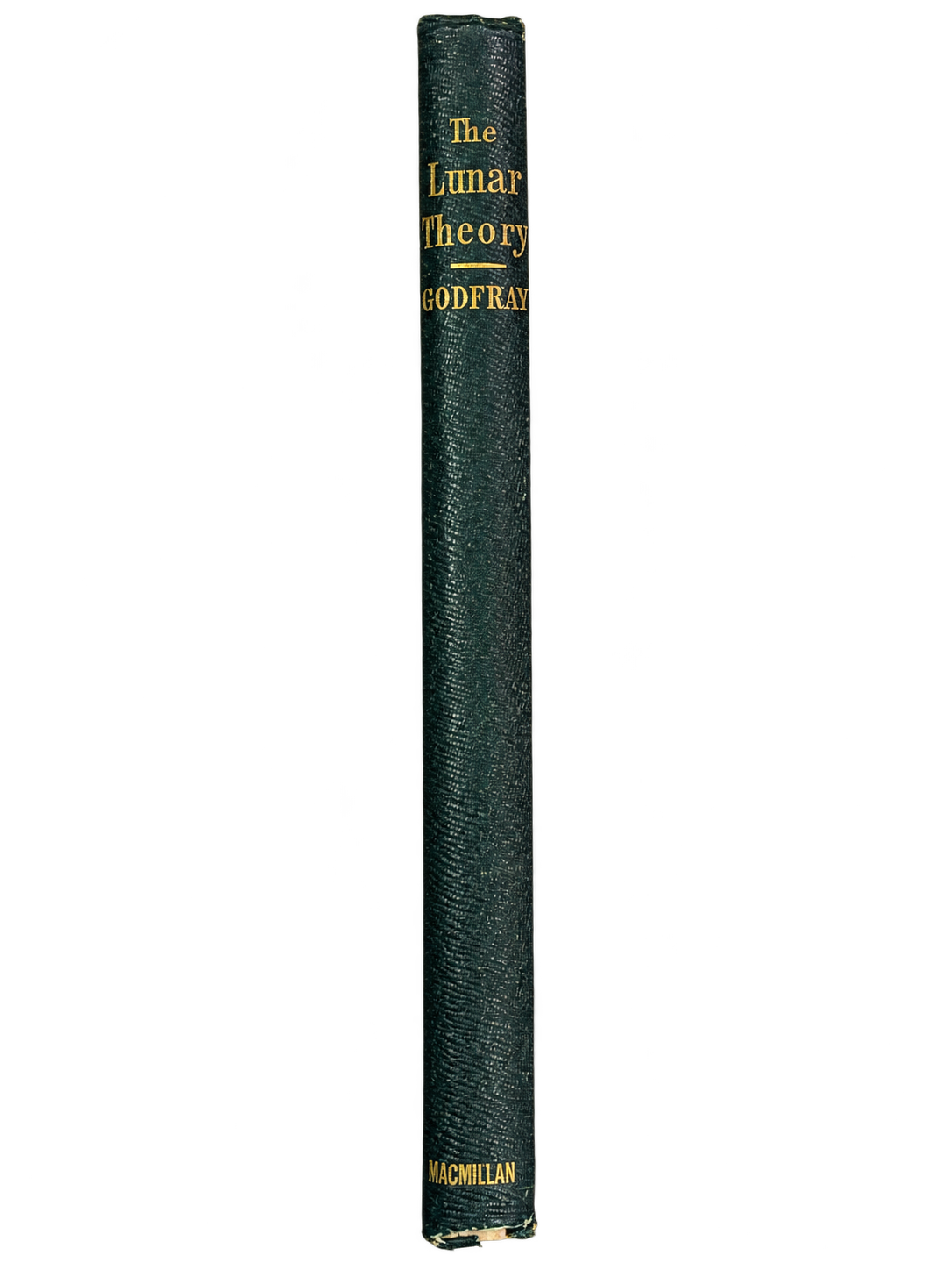
About this book
Published by Macmillan in 1859, this revised second edition introduces the mathematical problem of predicting the Moon’s motion under the gravitational influence of both Earth and Sun. Godfray develops successive approximations to explain departures from a simple elliptical orbit, presenting an accessible route into the demanding three-body problem.
The book records the teaching of Newtonian celestial mechanics in the Cambridge mathematical tradition. Its historical sketch traces earlier attempts to represent lunar motion up to Newton, including the work of Hipparchus, Ptolemy, Copernicus and Tycho Brahe. Accurate lunar predictions had practical importance for astronomy and the lunar-distance method of finding longitude at sea; this volume teaches the underlying theory.
This copy retains its dark cloth binding with gilt spine lettering, with wear and losses at the spine ends. A newspaper eclipse clipping dated February 10, 1963 is attached to an opening leaf, alongside a handwritten ownership name that remains unattributed. These additions preserve a later reader’s engagement with the subject.