About this book
This 1764 second English edition presents Pierre Joseph Macquer’s influential synthesis of chemical theory and laboratory practice. His textbooks helped make chemistry a systematic subject that could be learned through ordered principles and experiments, rather than through isolated recipes. Chemical affinity—the differing tendencies of substances to combine or displace one another—provided a framework for explaining reactions before modern atomic and bonding theories.
The work also preserves the phlogiston-based chemistry that preceded Lavoisier’s oxygen theory, making it a record of how eighteenth-century chemists organized experimental knowledge before the chemical revolution. Its contemporary readership is documented by surviving 1767 notes on the 1764 edition in the Historical Medical Library of the College of Physicians of Philadelphia.
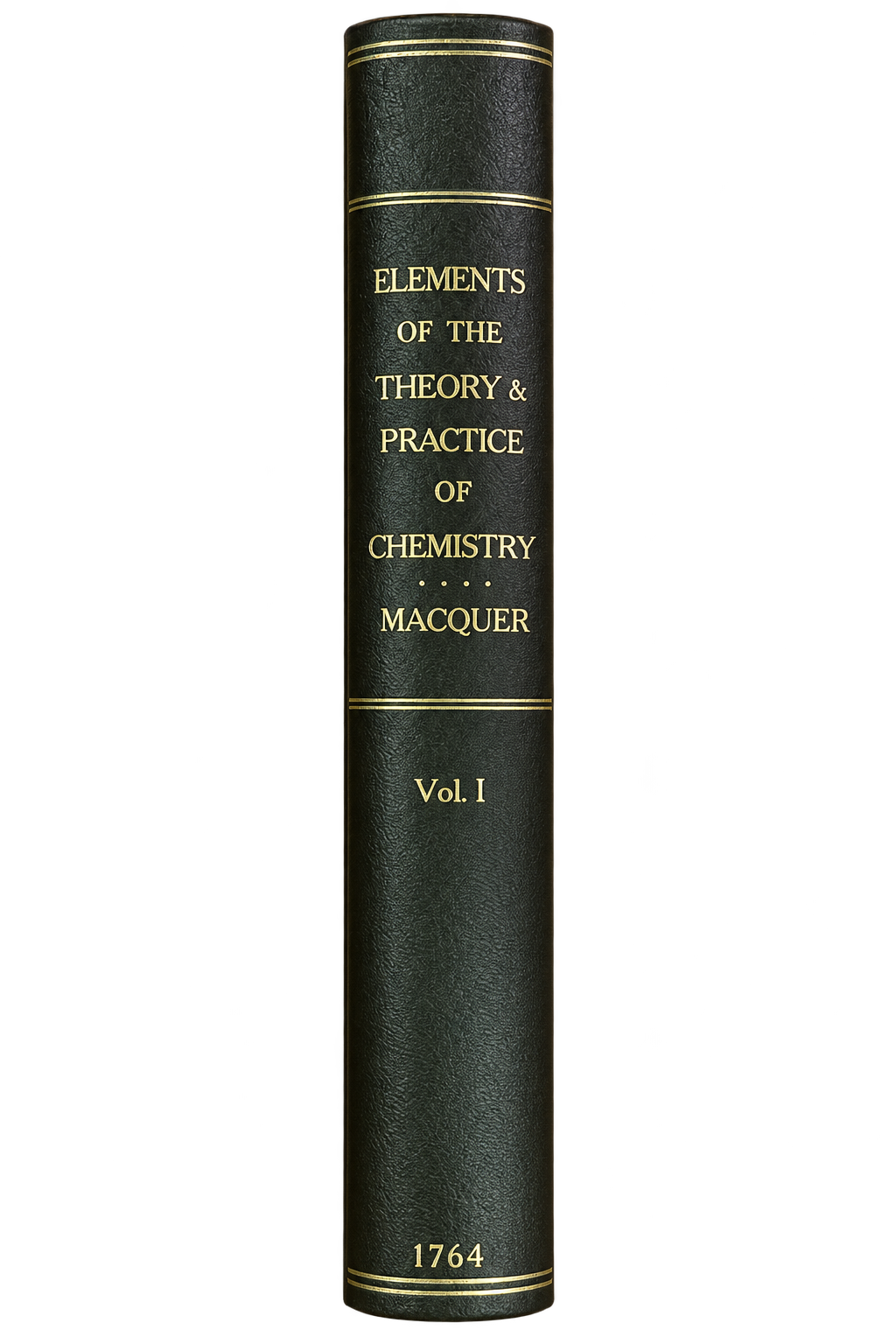
This copy is volume I of the two-volume work, in a later brown binding, with a foxed and annotated title page. An owl bookplate names William B. Jensen, consistent with ownership by the chemistry historian. Jensen’s published research specifically discusses chemical affinity in this edition; use of this particular copy has not been established.